

Dental Implants in St. Peters & Wentzville, MO
Permanent Tooth Replacement
Dental implants are changing the way people live! They are designed to provide a foundation for replacement teeth which look, feel, and function like natural teeth. The person who has lost teeth regains the ability to eat virtually anything and can smile with confidence, knowing that teeth appear natural and that facial contours will be preserved.
Want to learn more? Call Us Today or read some of our Frequently Asked Questions.
Smile with confidence!
Want to learn more or ready to schedule a consultation? Don't wait! Give your teeth the care they deserve and contact us today!
Dental Implants
The implants themselves are tiny titanium posts that are inserted into the jawbone where teeth are missing. These metal anchors act as tooth root substitutes. They are surgically placed into the jawbone. The bone bonds with the titanium, creating a strong foundation for artificial teeth. Small posts are then attached to the implant, which protrude through the gums. These posts provide stable anchors for artificial replacement teeth.
Dental implants also help preserve facial structure, preventing the bone deterioration that occurs when teeth are missing.
The Difference Between an Implant and a Bridge
A Dental implant is used to replace one missing tooth. It is placed in the site of the tooth that is missing and feels and behaves just like a normal tooth. It is a one to one replacement of the tooth. A bridge is used to span the gap of the missing tooth. The teeth on either side of the missing tooth are prepared by removing sufficient tooth structure to place a prosthetic tooth on each adjacent tooth and a false tooth in between that will bridge the gap. It is a three to one replacement, meaning that three sites are being used to restore the missing tooth.
The Dental Implant Surgery
For most patients, the placement of dental implants involves two surgical procedures. First, implants are placed within your jawbone. For the first three to six months following surgery, the implants are beneath the surface of the gums gradually bonding with the jawbone. You should be able to wear temporary dentures and eat a soft diet during this time. At the same time, your dentist is forming new replacement teeth.
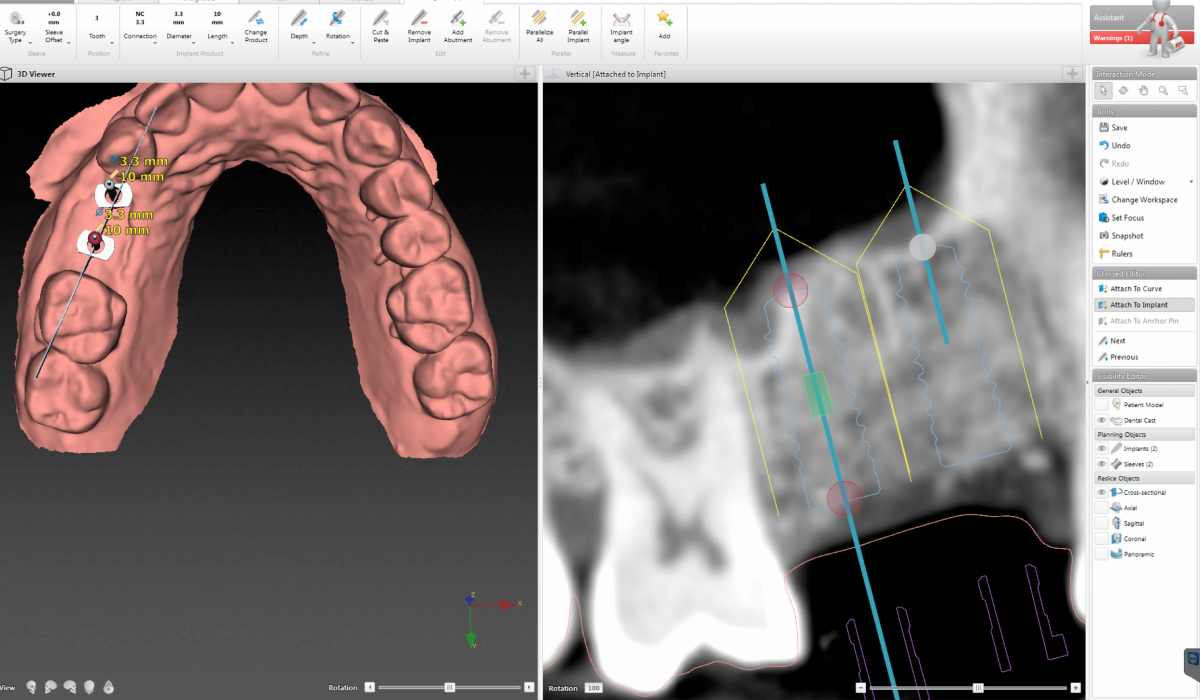
We utilize state of the art technology and imaging to plan your treatment.
After the implant has bonded to the jawbone, the second phase begins. The doctors will uncover the implants and attach small posts, which will act as anchors for the artificial teeth. These posts are just above the gum level. When the artificial teeth are placed these posts will not be seen. The entire procedure usually takes six to eight months. Most patients experience minimal disruption in their daily life.
Recovery After Implant Surgery
The large majority of patients report that the implant surgery itself is much easier than even having the tooth extracted. The recovery is also usually easier as well. There is minimal discomfort and patients usually return to their routine within a few days.
Immediate Implants
With newer technology and with the coordination of your restorative dentist, implants can sometimes be placed at the time of extraction in a single procedure. A consultation with your Dentist and Oral & Maxillo-Facial Surgeon is necessary to see if you are a candidate for Immediate Dental Implant Placement.
Dental Implants Presentation
To provide you with a better understanding of dental implants, we have provided the following multimedia presentation. Many common questions pertaining to dental implants are discussed.

Dental Implants Frequently Asked Questions (FAQ)
Answers to Common Questions About Dental Implants
- What are the types of dental implants?
- Are dental implants painful?
- What is the timeline for tooth extraction and dental implant placement?
- Is there a downside to dental implants?
- What are the three stages of dental implants?
- What is the Average Cost of Dental Implants?
- Can’t find an answer to your question?
What are the types of dental implants?
There are three main types of dental implants used to replace missing teeth. The appropriate type of implant for you is determined based on various factors. Your surgeon will explain your options and design a detailed treatment plan around the type of dental implant chosen.
- Endosteal Implants – These are the most commonly used type of dental implant. The implants are typically made of titanium and resemble small screws. They are surgically placed in the jawbone and, once healed, support the crown, permanent denture, or other restoration.
- Subperiosteal Implants – Some patients do not have enough jawbone mass or height to support endosteal implants. Subperiosteal implants are placed beneath the gums but on top of the jawbone. The prosthetic tooth or teeth are supported by a metal framework attached to the implant posts protruding from the gums.
- Zygomatic Implants – These specialized implants are reserved for patients with significant bone loss in the upper jaw. Instead of the dental implants being anchored in the jawbone, they are implanted in the cheekbones using longer titanium screws. Zygomatic implants are an alternative for patients who may otherwise need bone grafting.
Are dental implants painful?
During implant surgery, we use a local anesthetic to numb the jawbone and gums. We may also administer sedation to relax you and relieve any pain or anxiety. During recovery, you will have some swelling and mild discomfort for the first week. These can be alleviated with medication and ice packs for the first three days. After three days, you can switch to warm compresses to soothe any discomfort. Most patients are surprised by how little pain they feel following implant surgery and how quickly they recover.
What is the timeline for tooth extraction and dental implant placement?
Teeth extractions must allow time for the tooth sockets and surrounding soft tissues to heal before dental implants can be surgically placed. For most patients, the wait is between 10 weeks and three months. The timeframe can vary depending on the patient’s overall health and how rapidly they recover. In rare cases, an implant can be placed in the jawbone immediately after extraction, with healing and osseointegrations taking place simultaneously.
Is there a downside to dental implants?
While dental implants are often the best solution for missing teeth, they do come with a few downsides every patient should consider.
- Cost is an issue for many patients. With the price of replacing a missing tooth with an implant starting at $1,500, it is not an inexpensive solution. However, dental implants last significantly longer than any other dental restorations and are less expensive to care for over time.
- Time Constraints are also an issue for some people. From the initial consultation to the final restorations, the process can take anywhere from several weeks to over a year. The timeframe depends on several variables, including your oral health, the type of implants, and whether you need bone grafting or periodontal treatment before implant surgery.
- Complications of Surgery are rare with dental implants, but there is always a chance of infection, excessive bleeding, or the body’s rejection of the implants.
What are the three stages of dental implants?
- Implant Placement – Surgically implanting the implants in the jawbone. After placement, it takes several months for the implants to integrate fully with the jawbone.
- Abutment Attachment – The abutment is a slender post or pin inserted into the implant to connect the implant to the replacement tooth. Once the abutments are attached to the implants, the gums must heal around them, which takes a few weeks.
- Prosthetic Attachment – After the implants and abutments are integrated and the gums have healed sufficiently, the prosthetic teeth are attached.
What is the Average Cost of Dental Implants?
The cost of dental implants can vary widely depending on the type of implants, the amount of surgery needed, whether additional procedures are required, and how many implants are placed. However, a single dental implant usually starts at around $1,500, while a full mouth restoration using multiple implants can begin at $20,000 each for the upper and lower jaw.
While these prices may seem daunting, consider the many benefits, including a lifetime of eating, drinking, and speaking without worry. Over time, dentures and other solutions need frequent repairs and replacement, making them quite costly over the years.
The best way to know how much dental implants will cost you is to consult with one of our dental implant specialists. We will provide a detailed, accurate estimate based on your functional and aesthetic goals. Contact our office at Missouri Center for Oral Surgery & Implants at St. Peters Office Phone Number 636-928-7217 to schedule your appointment and learn more about how dental implants can change your life.
Can't Find an Answer to Your Question?
If you have any questions or concerns you need clarified, don't wait! Contact us today to get the help you need.